When preparing for a trip from India to Vietnam, the passport may seem like the simplest part of the visa process. After all, it is already in your hands and …

By Steven · Reviewed on October 15, 2026
If you hold an Indian passport, you can’t just land in Hanoi or Ho Chi Minh City and walk through immigration: you need a visa first. The good news is that the process is now mostly online, and for most holiday trips it comes down to one form and a USD 25 government fee. I’m Steven, and I’ve worked in tourism for over 15 years, arranging tours, hotels, restaurants, attractions and visas for travellers from all over the world, especially from India, so I know the current rules and where people go wrong. In this guide I’ll cover who needs a Vietnam visa for Indians, the three ways to get one, what each really costs, the Phu Quoc rule, and the mistakes that slow people down.
Quick answer:
| Question | Answer |
| Do Indians need a visa for Vietnam? | Yes, for mainland Vietnam |
| Easiest option | Vietnam e-visa (online) |
| Official e-visa fee | USD 25 (single entry) / USD 50 (multiple entry) |
| Maximum validity | Up to 90 days |
| Official processing time | 3 working days (allow 3 to 5 in practice) |
| Visa-free exception | Phu Quoc Island, up to 30 days (strict conditions) |
| Passport | Valid 6+ months beyond arrival, at least 2 blank pages |
Want it done for you? We’re Vietnam Immigration, a visa service run by a team with 15 years in Vietnam tourism. We handle the Vietnam visa for Indians from start to finish, and we can apply for your e-visa online: simple, safe and fast, with help filling in the form, a document check and support when you arrive. Your visa is guaranteed, or you get a full refund (see our cancellation and refund policy). Exact prices are in the cost section below.
The Vietnam visa requirement for Indian citizens is simple: you must hold a valid visa before you enter mainland Vietnam. India is not on Vietnam’s visa-exemption list, so there is no visa-free entry for tourism, business or family visits at airports such as Hanoi, Ho Chi Minh City or Da Nang. The one notable exception is Phu Quoc Island, covered in the next section. Holders of an APEC Business Travel Card that lists Vietnam (VNM) on the back can generally enter without a visa for business trips of up to 60 days, so check your card’s conditions if you have one. For a deeper breakdown, read our full Vietnam visa requirement guide for Indians.
Here is what you need to have ready:
| Item | What is required |
| Passport | Valid for at least 6 months beyond your arrival date, with at least 2 blank pages |
| Photo | Recent colour photo, white background, face straight to the camera, no glasses. A digital file for the e-visa; printed photos (usually 4×6 cm) for visa on arrival and embassy applications |
| Passport data page | A clear scan or photo of the page with your photo and personal details |
| Travel details | Entry date, entry and exit ports, and your address in Vietnam |
| Payment | An international debit or credit card (with international transactions enabled) for the e-visa fee |
| Approval letter | Only for visa on arrival, issued online before you travel |
For a tourist e-visa you do not normally upload flight tickets or bank statements. Immigration officers can still ask for proof of onward travel and accommodation, so keep copies on your phone and on paper. Some other visa types (business, work, long-term) need extra documents such as an invitation or a work permit.
A few travellers fall under separate rules. If you or a close family member is of Vietnamese origin, ask the embassy whether a visa exemption certificate applies to you. Holders of diplomatic or official passports also have their own arrangements.
Since August 2023, Vietnam has offered a 90-day e-visa, single or multiple entry, to citizens of all countries, including India. This is the route most Indian travellers choose today.
Phu Quoc visa for Indians is the one big exception: you can arrive without a visa and stay up to 30 days. It sounds simple, but the rules are narrower than most blog posts suggest, and they matter more than the headline. The exemption covers foreign visitors of all nationalities, and here is what it means for your booking:
If you want to continue to Ho Chi Minh City, Da Nang or anywhere else on the mainland, you need a proper visa such as an e-visa, ideally obtained before you fly. For the full breakdown, read our guide Do Indians need a visa to visit Phu Quoc Island?
Why the Indian Embassy advises getting a visa anyway. In April 2026 the Embassy of India in Hanoi urged Indians to obtain a Vietnamese visa even for Phu Quoc-only trips. The Embassy’s worry is simple: without a visa you can’t legally leave the island to reach a mainland hospital or rebook a flight. Applying for an e-visa in advance costs far less than being stuck without one, and the steps are explained below.
There are three practical ways of getting a visa for Vietnam as an Indian citizen: the e-visa, the visa on arrival, and a visa from a Vietnamese embassy or consulate in India. Here is how they compare:
| Option | Where you apply | Processing time | Official fee | Best for |
| E-visa | Online | 3 working days officially, usually 3 to 5 | USD 25 single / USD 50 multiple | Most tourists |
| Visa on arrival | Approval letter online, visa stamped at the airport | Letter usually 3 to 5 working days | Stamping fee USD 25 single / USD 50 multiple, in cash | Air travellers who want an agent’s help |
| Embassy or consulate visa | Embassy in New Delhi or Consulate General in Mumbai | Typically 5 to 7 working days | Varies by visa type | Visa types not available online |
The Vietnam evisa for Indians is issued online by the Vietnam Immigration Department. It is valid for up to 90 days, can be single or multiple entry, and is accepted at designated international airports, land border gates and seaports. Check the official list of entry points and use the one you declare in your application. For details on validity, documents and entry ports, see our guide to Vietnam e-visa for Indians: required documents, entry ports and validity, and if you land in Saigon, read about entering through Ho Chi Minh airport on an e-visa.
How to apply:
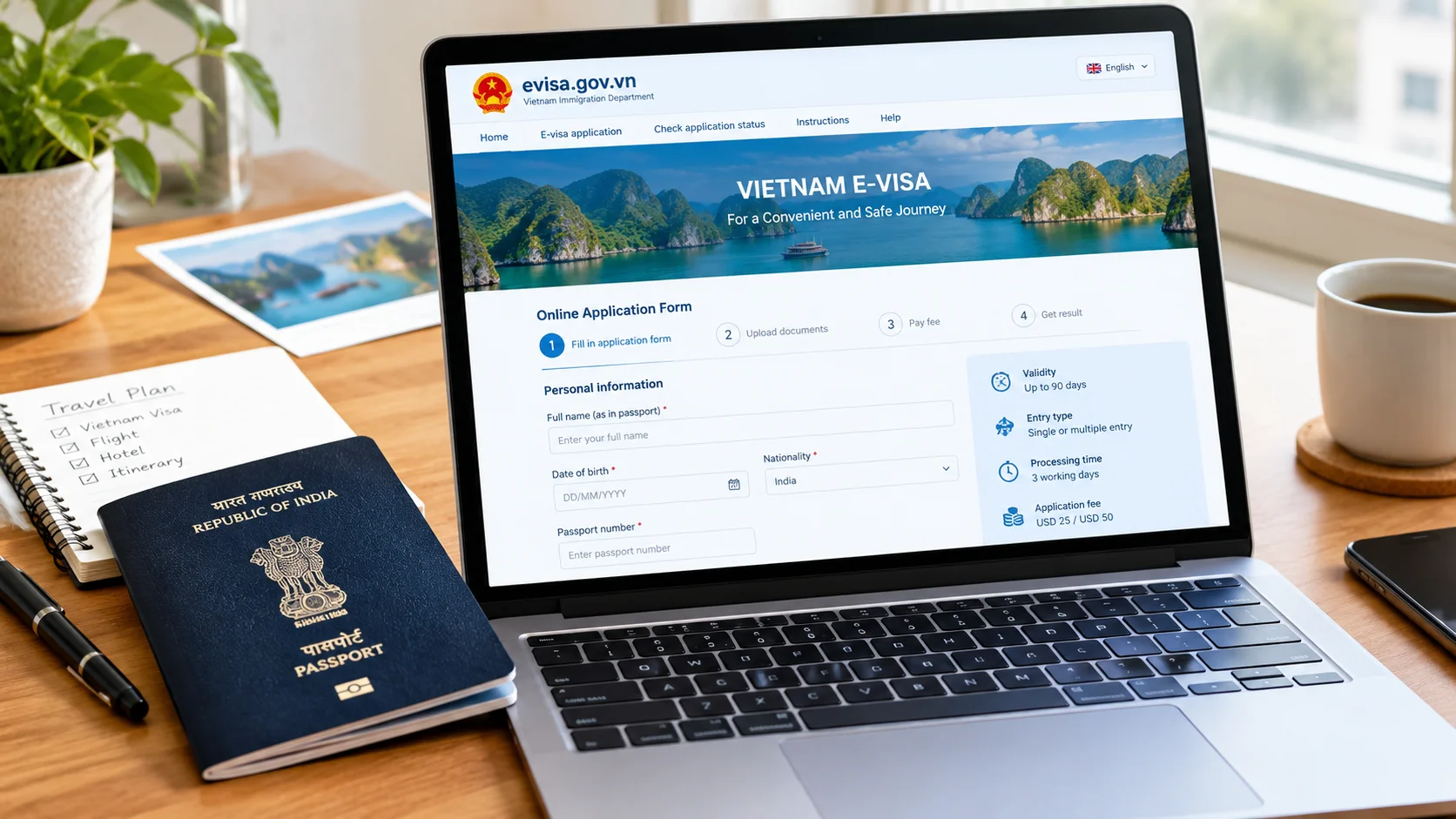
How long it takes: the official processing time is 3 working days, counted from a complete application and payment, and it excludes weekends and Vietnamese public holidays. In practice results often arrive in 3 to 5 working days, and slower periods or requests for corrections can add more. Apply at least one to two weeks before you fly.
Why e-visas get delayed (from my experience helping Indian travellers): most delays come from errors in the form or the documents, not from the system. The e-visa system reads the ICAO lines on your passport (the two lines of characters at the bottom of the data page) to pull your name, date of birth and passport expiry, so in our experience that information is about 99% accurate. The risk is in what you type yourself: entry date, entry port, address and visa type. Then come the files: a passport photo with glare or blur, a cut-off ICAO line, or a scan of two facing pages when the form needs only the single page with your personal data. Portrait photos cause trouble too: glasses, a cap or head covering that hides part of the face, a background that is not white, or a portrait copied from an old passport photo instead of a recent one. Fixing any of these after you submit usually costs you days you may not have. Whatever the outcome, the government fee isn’t returned, so double-check before you pay.
If the portal feels like a hassle, you don’t have to do it alone. We can apply for your e-visa for you: we check your details before submitting, so mistakes get caught early, and we stay with you until you have entered Vietnam. Standard results take 3 to 5 working days, and there is an urgent option if you are short on time. Nobody can promise the government’s decision, so we back every application with a simple guarantee: you get your visa, or you get your money back in full.
The Vietnam visa on arrival for Indians is the option people most often misunderstand. The letter you get online isn’t your visa; it’s permission to collect one at the airport. You first get an approval letter through a licensed agency, then show it at the visa counter when you land, hand over your passport, form and photo, pay the stamping fee and receive the stamp. It works fine, but it means a queue and cash after a long flight, so I only recommend it when someone prefers the agent route or has a very tight schedule.
If you go this route, use a trusted provider. We can issue your visa on arrival approval letter in 3 to 5 working days, with urgent options, guide you on what to expect at the airport, and back it with our guarantee of a visa or a full refund. Not sure it applies to you? Read whether Indian passport holders can apply for a Vietnam visa on arrival.
Going through the Vietnam embassy in India is rarely worth it for a holiday. Vietnam has an Embassy in New Delhi and a Consulate General in Mumbai (see the latest embassy address, website and telephone details). You get a visa sticker in your passport before you fly, which suits visa types that are not offered online, such as work or long-term visas.
The trade-offs: you must submit your passport and documents in person or through an authorised channel, and processing typically takes 5 to 7 working days, so it is usually the slowest and least convenient option for a holiday. Embassy fees and hours change, so call or check the embassy’s own website the week you plan to go.
Unless you need a visa type that is not available online, an e-visa is generally faster and simpler.
There are two numbers to keep apart when you work out the Vietnam visa cost for Indian travellers: what the government charges, which is the same for everyone, and what an agent charges for doing the work. The government fees below are the published 2026 figures, but fees can change, so confirm on the official portal before paying.
| Visa route | Single entry | Multiple entry |
| E-visa (government fee, paid online) | USD 25 (about INR 2,100 to 2,300) | USD 50 (about INR 4,200 to 4,600) |
| Visa on arrival (stamping fee, paid in cash at the airport) | USD 25 | USD 50 |
| Embassy or consulate visa | Varies by visa type, confirm with the embassy | Varies by visa type, confirm with the embassy |
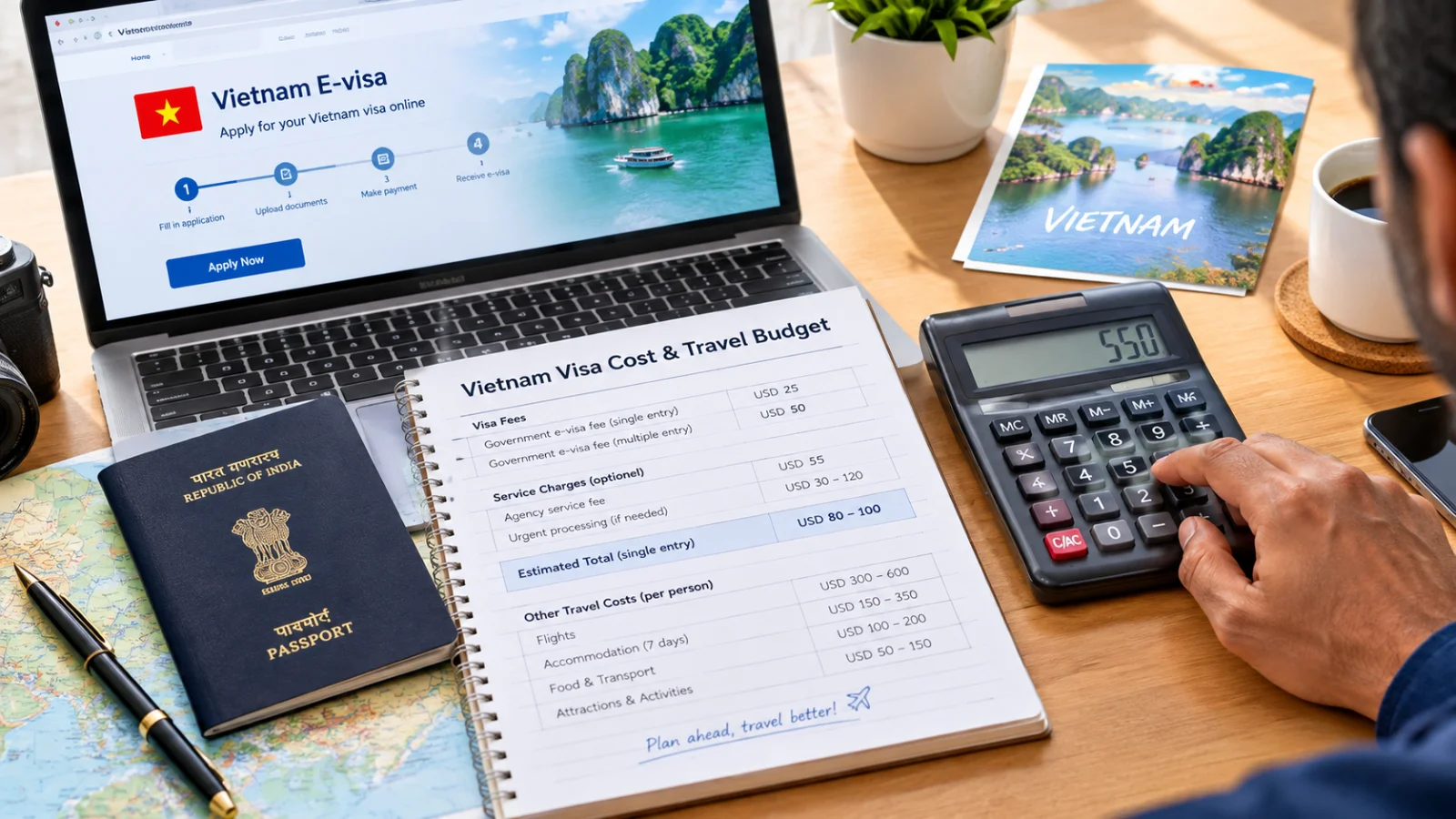
INR amounts are approximate and move with the daily exchange rate. The government e-visa fee isn’t returned whatever the outcome, so double-check before you pay.
The official Vietnam evisa price for Indians is USD 25 for a single-entry visa and USD 50 for a multiple-entry visa, both valid for up to 90 days. Payment is by card on the portal’s last step, so make sure your card allows international payments before you start.
If you want expert help, our visa service adds a separate fee on top of the government fee, and we guarantee your visa or a full refund. Here are our current prices for a 30-day single-entry e-visa:
| Service | Government fee | Service fee | Total | Result in |
| Standard e-visa | USD 25 | USD 55 | USD 80 | 3 to 5 working days |
| Urgent e-visa | USD 25 | USD 55 plus an urgent fee of USD 50 to 120 | USD 130 to 200 | 4 hours to 2 working days |
Our service fee covers help filling in the form, a check of your documents, a simpler process, accurate visa details, answers to your questions and support when you enter Vietnam. The urgent fee depends on how fast you need the result. Flying tomorrow? See our guide to expedited Vietnam visas for Indians.
How much for Vietnam visa on arrival for Indians? You make two separate payments: a service fee for the approval letter at the time of application, and the government stamping fee in cash at the airport. These are our prices for a single-entry visa:
| Service | Approval letter fee | Stamping fee (cash, at the airport) | Total | Letter ready in |
| Standard approval letter | USD 45 | USD 25 | USD 70 | 3 to 5 working days |
| Urgent approval letter | USD 100 to 160 (USD 45 plus USD 55 to 115 urgent fee) | USD 25 | USD 125 to 185 | 4 hours to 2 working days |
A multiple-entry visa on arrival has a USD 50 stamping fee instead of USD 25. Because of the cash payment and the airport queue, the total effort is usually higher than with an e-visa, so compare both before you decide.
The fee to get a visa at the Vietnam embassy in India depends on the visa type (tourist, business, work or long-term), its duration and the number of entries. The embassy sets these amounts and can change them, and published figures online often mix official fees with agency charges. For the current rate, check the official website of the Embassy of Vietnam in New Delhi or the Consulate General in Mumbai, or contact them directly. Also budget for courier costs and travel if you do not live near these cities.
Flying in a day or two? Our urgent visa service delivers much faster than the 3 to 5 working days of the standard process. All prices are per person.
Urgent e-visa (government fee included, nothing more to pay on arrival):
| Speed | Total price |
| Within 2 working days | USD 130 |
| Within 1 working day | USD 160 |
| Within 4 working hours | USD 200 |
Urgent approval letter for visa on arrival (you also pay the single-entry stamping fee of USD 25 in cash at the airport):
| Speed | Approval letter fee | Plus stamping fee at the airport |
| Within 2 working days | USD 100 | USD 25 |
| Within 1 working day | USD 130 | USD 25 |
| Within 4 working hours | USD 160 | USD 25 |
Prices for other visa types, such as a business e-visa, differ, so ask for a quote before you pay.
Here are the step-by-step instructions to apply for Vietnam visa as an Indian traveller. The e-visa path is the fastest and simplest for most people.
Option 1: e-visa (recommended). For a detailed walkthrough, see our guide on how to get a tourist e-visa for Vietnam as an Indian.
Option 2: visa on arrival
Option 3: embassy or consulate
Vietnam now asks international visitors to submit a short, free online declaration before they reach immigration. It is separate from your visa, so getting the visa is no longer the only thing to prepare.
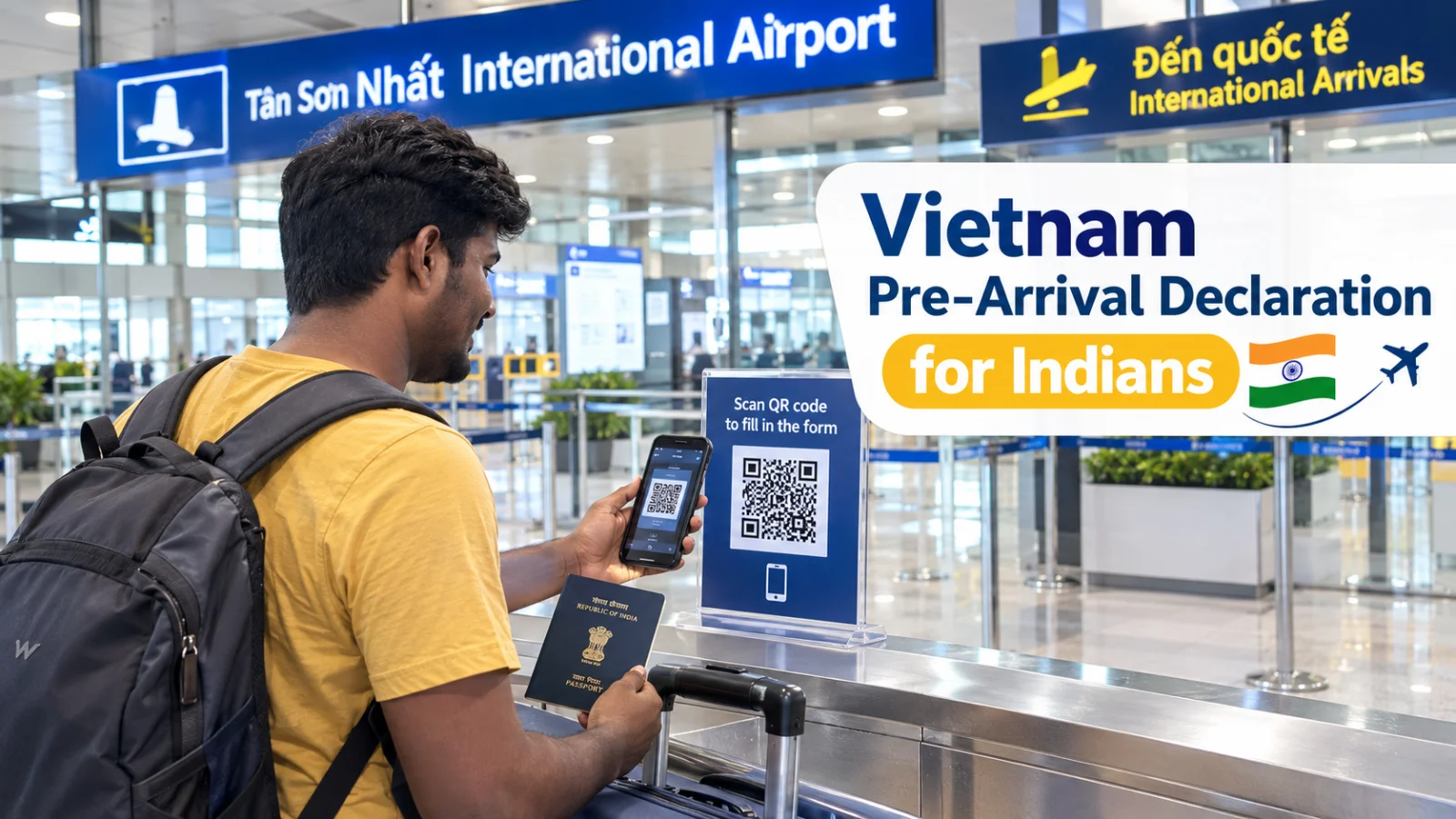
The declaration does not replace a visa. You still need a valid e-visa, visa on arrival approval or an exemption such as Phu Quoc’s.
Want the easy route? Start your Vietnam visa application with Vietnam Immigration and let the team check every detail for you. Your visa is guaranteed, or you get a full refund.
After you apply, you can check your Vietnam visa status online on the official portal. You need three details from your application:
Here is how to check:
Take a screenshot of your registration code the moment you pay. It is the only key to your application. If your status still shows processing after 5 working days, check your email (including spam) for a request to correct a photo or detail, then correct it on the portal. If there is no change after about 10 working days, you lost your code, or you cannot download an approved e-visa, use the contact details on the official portal to reach the immigration department. If you applied through Vietnam Immigration, you can also ask the support team to check for you. Submit your application at least one to two weeks before your travel date, and earlier in holiday seasons.
These situations come from our recent files. Details are changed to protect our customers’ privacy, and the lessons apply to almost every trip.
An Indian traveller flew direct from Singapore to Phu Quoc and entered under the Phu Quoc visa exemption. A few days later they planned to fly home to New Delhi with a connection in Ho Chi Minh City, assuming a transit would be fine. At the airport, staff refused to let them fly because they had no visa to enter Ho Chi Minh City. They contacted us, but by then nothing could be done: a traveller who entered under the Phu Quoc exemption can only leave Vietnam directly, without connecting anywhere else in the country. They had to cancel their ticket and buy another flight, which cost far more.
The lesson: if your trip touches Phu Quoc, check both your arriving and your departing route. If either one connects through another Vietnamese airport or seaport, get a visa before you go.
A family from Mumbai planned a holiday in Phu Quoc. They could not book a direct flight, so their route connected through Ho Chi Minh City, and they assumed the Phu Quoc exemption still covered them. They only realised close to departure that they needed a visa and contacted us. They submitted at about 6:30 AM, so we arranged an urgent e-visa at USD 130 per person, government fee included, and the visas were ready the same day. They were very relieved.
The lesson: a connection in another Vietnamese city turns a visa-free trip into one that needs a visa. Sort it out as soon as you book your tickets, not the week you fly.
An Indian business owner contacted us at 11:25 AM on October 13, 2026. They had an urgent meeting in Ho Chi Minh City the next day and needed a visa that same day. I explained the urgent options and recommended a same-day business e-visa at USD 210, and they agreed. At 4:10 PM we sent the e-visa, together with a link to verify it on the official website and clear instructions on how to use it. The next day they entered Vietnam smoothly, and the meeting went well.
The lesson: when time is short, same-day service is possible, but it only works if your passport scan and photo are clear and your details are accurate.
These figures come from the Indian applications we handled in the three months to October 2026, plus what we see from travellers who apply on their own.
| What we measured | What we see |
| Approval rate of Indian applications we handled | 100% over the last 3 months |
| Cases finished later than estimated | About 1 to 2%, usually by a couple of hours (approved at 6 PM instead of 4 PM). We tell customers in time and offer a solution |
| Processing time when Indian travellers apply on the government site themselves | 3 to 5 working days on average. Some take up to 10 days when information is wrong and files must be uploaded again |
| Processing time in peak periods | Typically 4 to 6 days. Many travellers ask for urgent service in these periods |
Peak periods are the Indian holiday seasons (such as Diwali, summer holidays and New Year), when many Indian travellers head to Vietnam, and Vietnamese public holidays such as Tet. Add a few days to your timeline, and apply early.
The most common mistakes we see from Indian applicants are all easy to avoid:
What is the Vietnam visa for Indians, and who needs it? Indian passport holders need a visa to enter mainland Vietnam. Most travellers apply for the online e-visa (USD 25 for a single entry, valid up to 90 days). The alternatives are visa on arrival and an embassy visa. Phu Quoc is the only visa-free exception, for up to 30 days and under strict conditions.
How much does a Vietnam visa cost for Indians? The official e-visa fee is USD 25 for a single entry and USD 50 for multiple entries. Visa on arrival has a USD 25 (single) or USD 50 (multiple) stamping fee paid in cash, plus an approval letter fee. Embassy fees vary by visa type. With us, a 30-day single-entry e-visa is USD 80 in total (USD 25 government fee plus USD 55 service fee).
How long does it take to get a Vietnam visa? The official e-visa processing time is 3 working days, and in practice it usually takes 3 to 5. Embassy visas typically take 5 to 7 working days. Urgent services can deliver an e-visa or approval letter in 4 hours to 2 working days.
Can Indians get a visa on arrival in Vietnam? Yes, but only with a pre-approved letter obtained online before you travel, and only at Vietnam’s international airports. You pay the stamping fee in cash at the airport counter.
Do Indians need a visa for Phu Quoc? Not for up to 30 days if you fly or sail directly from abroad into Phu Quoc, stay on the island and leave directly from Phu Quoc to a country outside Vietnam. If your arriving or departing journey transits any other airport or seaport in Vietnam, such as Ho Chi Minh City, you need a visa. The Embassy of India in Hanoi also advises getting a visa in advance in case an emergency forces you onto the mainland.
How many blank pages do I need in my passport? At least 2 blank pages, and the passport must be valid for 6+ months beyond your arrival date.
Is the Vietnam e-visa fee refundable? No. The government fee isn’t returned whatever the outcome, so check every detail before you submit.
Is my visa guaranteed if I apply through Vietnam Immigration? Yes. We guarantee your visa, or you get a full refund of your payment. Read the full cancellation and refund policy, or apply with us.
Can I extend my Vietnam visa? Extensions depend on your visa type and are handled by Vietnamese immigration authorities inside Vietnam, often through authorised agents. They are not guaranteed, so choose a visa validity that covers your whole trip.
Can I enter Vietnam by land or sea with an e-visa? Yes, at designated land border gates and seaports as well as airports. Check the official list and make sure your entry point matches the one in your application.
Do I need to fill in a pre-arrival form for Vietnam? Yes. International visitors who do not hold a Vietnamese passport must submit a free online pre-arrival declaration at prearrival.immigration.gov.vn, up to 3 days before arrival, and show the QR code at immigration. It applies to e-visa holders and visa-free visitors alike, and it does not replace your visa.
The Vietnam visa for Indians comes down to one rule and three routes: you need a visa for mainland Vietnam, with Phu Quoc as the one exception, and only under strict conditions. For most trips the Vietnam e-visa is the best balance of price, speed and convenience: USD 25 for a single entry or USD 50 for multiple entries, valid for up to 90 days, with results usually in 3 to 5 working days. The visa on arrival and the embassy route are for specific situations.
If you remember only four things: apply online, check that your passport has 6 months of validity and 2 blank pages, complete the free pre-arrival declaration before you fly, and don’t leave it to the last week. In my experience, the trips that go wrong are almost always the ones where the visa was an afterthought. If you are short on time or unsure about anything, we can handle it for you: your visa is guaranteed, or you get a full refund under our refund policy.
Official sources: Vietnam e-visa portal and the VnExpress report on the Indian Embassy’s Phu Quoc advisory.
Visa rules and fees can change. Always verify the latest requirements on official Vietnamese government sources before you travel.
Steven has worked in the tourism industry for more than 15 years, providing tours, hotels, restaurants, attractions and visa services for travellers from all over the world, with a special focus on travellers from India. He writes this guide from what he has seen helping Indian travellers at Vietnam Immigration, and keeps it updated as Vietnam’s rules and fees change.
When preparing for a trip from India to Vietnam, the passport may seem like the simplest part of the visa process. After all, it is already in your hands and …
You have booked your flight from India to Vietnam, started planning where to stay, and perhaps already built an itinerary through Hanoi, Da Nang, or Ho Chi Minh City. Then …
For Indian travellers planning a trip to Vietnam, one question becomes especially important once the visa application enters the picture: how long will the Vietnam digital visa take to process? …
Searching for “Vietnam visa at airport for Indians” can lead to a deceptively simple idea: book your flight from India, arrive in Vietnam, find a visa counter and sort everything …
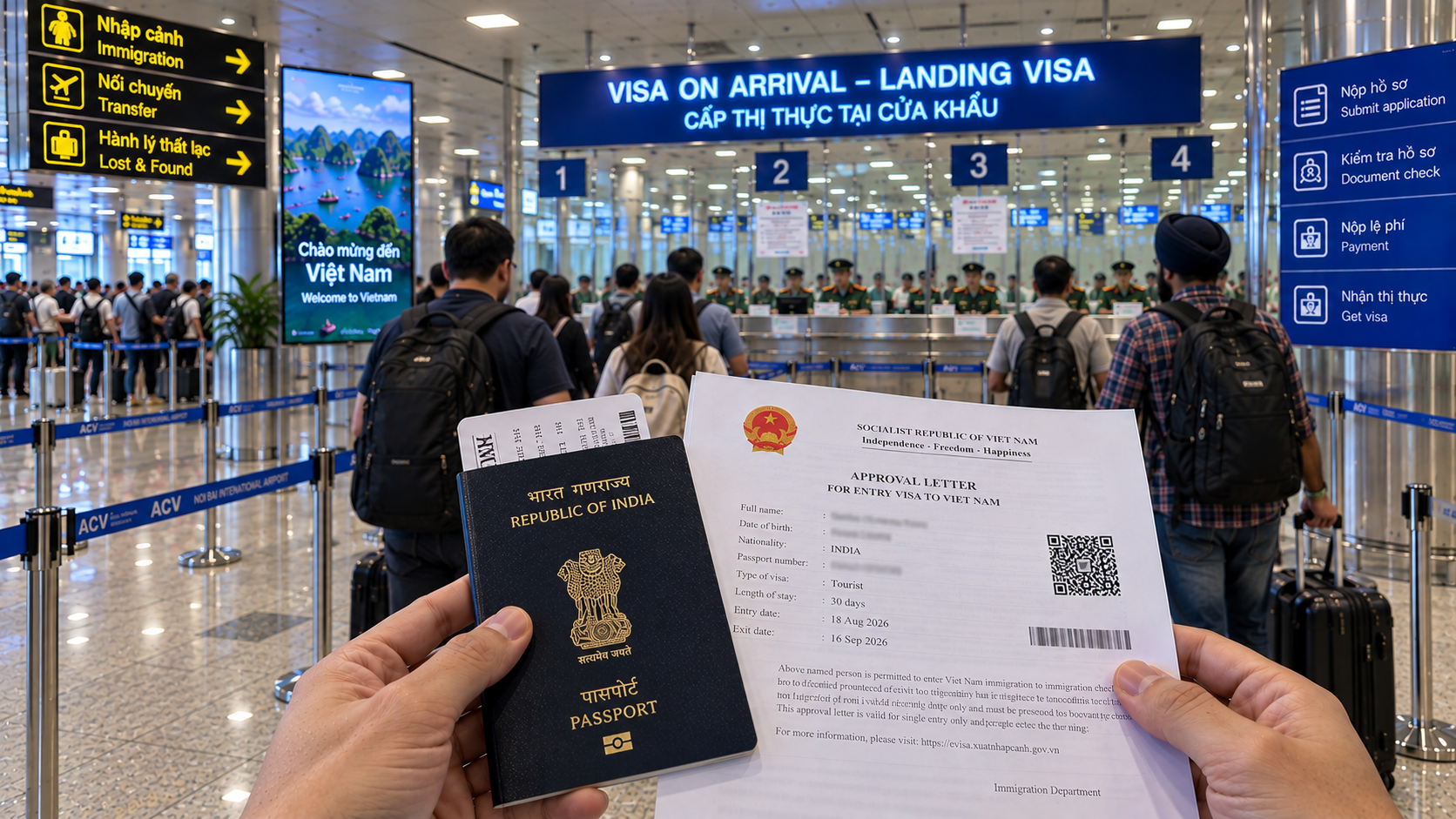
If you are travelling from India to Vietnam and have been told that you need a Vietnam immigration approval letter, it is perfectly reasonable to wonder what you are actually …
Planning to spend several weeks or close to three months exploring Vietnam? For Indian passport holders, the Vietnam e-visa can be issued for up to 90 days, making it a …
Planning a business trip from India to Vietnam may seem straightforward until the visa question arises. Many Indian entrepreneurs automatically search for a three-month Vietnam DN Visa because they assume …
Imagine you’ve spent weeks preparing for an important business trip to Vietnam. Your meetings in Ho Chi Minh City have been confirmed, hotel reservations are complete, flights have been booked, …
Vietnam has become one of the most attractive business destinations for Indian entrepreneurs, exporters, investors, and corporate professionals. With growing trade ties between India and Vietnam, an increasing number of …


