If you are travelling from Ireland to Vietnam and your departure date is approaching while your visa is still unresolved, you may be wondering whether you can simply board your …

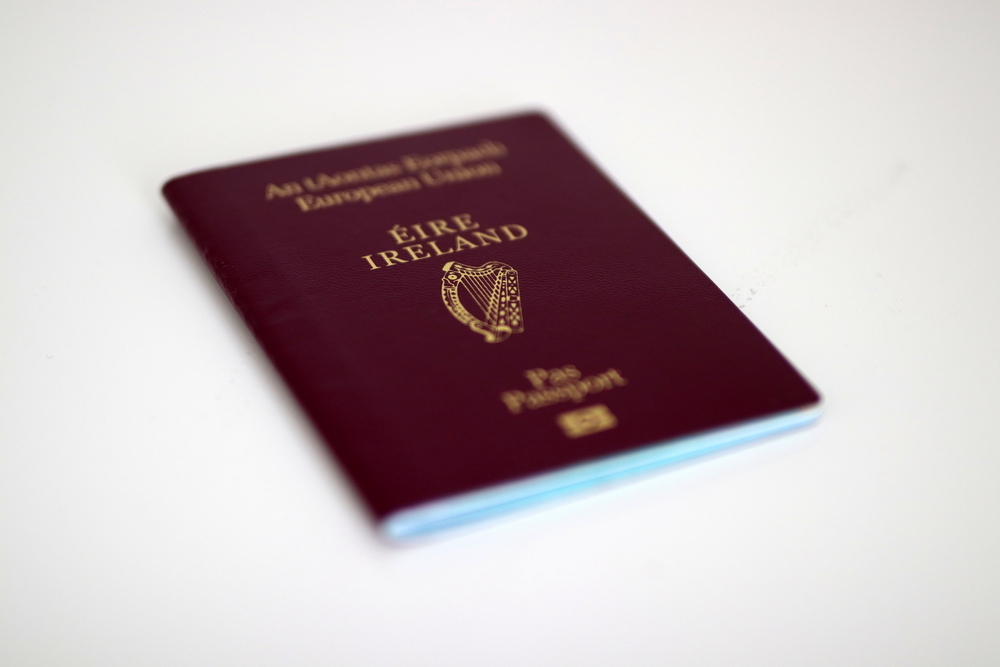
You have your flights from Ireland sorted, your accommodation is booked, and Vietnam is next on the itinerary. Then a term appears in your visa research that is not immediately obvious: “Vietnam pre-approved visa letter”. Is it the visa itself? Is it something you request at the airport? Or is it simply a supporting document that needs to be arranged before departure? The wording can be particularly confusing because it is often connected with Vietnam Visa on Arrival, which sounds as though the entire process takes place after your plane lands. In practice, where an approval-letter Visa on Arrival arrangement applies, the important work starts before you leave Ireland. The approval documentation is dealt with in advance, while the remaining visa formalities are completed after arrival at the appropriate Vietnamese airport. For Irish travellers, understanding that sequence is far more useful than trying to memorise every visa term used online.
A Vietnam pre-approved visa letter is documentation connected with the pre-arrival approval stage of an applicable Visa on Arrival arrangement. It is obtained before travel and is then used as part of the procedure completed after arriving in Vietnam.
You may also see it described as a Vietnam Visa Approval Letter or simply an approval letter. The terminology varies, but the practical question is always the same: does the document represent the complete visa, or does it allow you to proceed to the next stage?
For the process covered in this guide, it is the latter.
A useful way to picture the journey is:
Approval arranged before departure → travel documents prepared → flight to Vietnam → remaining visa procedure completed after arrival
This distinction matters because a traveller should not treat an approval document as though every part of the visa process has already been completed.

One of the most useful things an Irish traveller can do is look at the actual itinerary before choosing a visa route. How you enter Vietnam matters just as much as where you intend to spend your holiday.
If you are using an approval-letter route that involves completing Visa on Arrival formalities at an international airport, your travel arrangements need to fit that process. Flying directly into an applicable Vietnamese airport is very different from entering Vietnam overland after travelling through Cambodia or Laos.
For example, somebody may say they are “travelling to Nha Trang”, but their immigration entry point may actually be Cam Ranh International Airport. Likewise, a traveller touring several countries in Southeast Asia may first fly from Dublin into Bangkok and only enter Vietnam several days later through a completely different checkpoint.
The approval documentation should therefore be arranged around the actual Vietnamese entry point and travel plan, not simply the final destination written on the hotel booking.
This is where many travellers get caught out.
A pre-approved visa letter should not be treated as identical to the completed visa stage. Its purpose is to show that the relevant approval has been arranged so that the traveller can proceed with the applicable arrival procedure.
| Pre-Approved Visa Letter | Completed Visa Procedure |
|---|---|
| Arranged before travelling | Completed according to the applicable visa process |
| Serves as approval documentation | Represents the completed visa stage |
| Used during the arrival procedure | Used for entry under the visa conditions |
| Does not mean every airport formality is finished | Comes after the required arrival formalities are completed |
The practical takeaway is straightforward:
An approval letter is part of the process, not the whole process.
Receiving the document is an important milestone, but you still need to prepare the remaining paperwork and follow the required procedure when you reach Vietnam.
The phrase “Visa on Arrival” can give the impression that you simply fly first and deal with everything afterwards. That interpretation is too simplistic for the approval-letter process discussed here.
Where this route applies, the approval component is dealt with before departure. The airport stage comes later.
There is also a practical travel reason for having your documentation sorted before you reach the gate. Airlines may check whether passengers have the appropriate documents for their journey during check-in or boarding, depending on the route, nationality and applicable travel requirements.
So instead of thinking:
Ireland → flight → sort out visa
think:
Ireland → approval arranged → documents checked → flight → arrival formalities
That small change in thinking prevents a large amount of unnecessary confusion.

The fastest-looking application is not necessarily the best one if the passport information is wrong. Accuracy matters from the beginning because the approval documentation needs to correspond with the passport used for the trip.
An Irish traveller should be ready to provide the relevant details from the passport that will actually be presented during travel, along with the necessary itinerary information.
| Information | What to have ready |
|---|---|
| Passport details | Details from the passport you will travel with |
| Nationality | Irish |
| Intended date of arrival | Your planned date of entry into Vietnam |
| Arrival point | The Vietnamese international airport used for entry |
| Entry arrangement | According to the planned trip |
| Travel details | Flight or itinerary information where required |
If you renew or replace your passport after the approval documentation has been arranged, do not automatically assume the old paperwork can simply be used with the new passport. The details should be checked again before travel.
The same principle applies if your itinerary changes. A different flight or entry point can affect how your documentation should be reviewed.
When the approval document arrives, do not immediately file it away with the rest of your holiday paperwork. Open it and compare it carefully with your passport.
Check your full name, passport details, nationality and any relevant travel or entry information shown on the document. If dates or entry points are listed, compare them with your current itinerary rather than the itinerary you originally intended to use.
This is a simple habit, but it can make a significant difference. A discrepancy spotted while you are still at home in Ireland is much easier to investigate than one discovered after a long journey through several airports.
It is worth doing the check twice: once when the document is issued, and once again shortly before departure.
Another common mistake is to focus so much on obtaining the approval letter that the traveller forgets about the rest of the arrival paperwork.
For the Visa on Arrival process discussed in this article, the travel pack should include:
| Item | What to prepare |
|---|---|
| Passport | The valid passport corresponding with the approval |
| Visa approval documentation | The document arranged before departure |
| Photograph | 4 × 6 cm, white background |
| NA1 form | Completed for the arrival procedure |
| Stamping fee | USD25 for the single-entry arrangement discussed here |
Keep these items together somewhere accessible in your cabin baggage. Documents needed immediately after landing are not particularly useful if they are packed deep inside checked luggage.
For the single-entry arrangement described here, the airport stamping fee is USD25. This is separate from any earlier service or processing fee that may have been paid to arrange the approval documentation.
That distinction is worth knowing before you travel, because “approval processing fee” and “airport stamping fee” refer to different parts of the process.
After arrival, follow the airport instructions for the relevant landing-visa or Visa on Arrival processing area before continuing through the normal immigration channel.
The airport procedure generally involves presenting the required documents associated with your approval arrangement. For the process described here, that means having your passport, approval documentation, completed NA1 form, photograph and applicable stamping fee ready.
Once the documents have been processed and your passport is returned, take a moment to check the visa information before moving away from the counter. It is much easier to raise an obvious discrepancy while you are still in the processing area than after you have continued through the airport.
You can then proceed with the normal immigration process.
The important point is that the Vietnamese airport is the place where the remaining procedure is completed. It should not be viewed as the place where the entire approval application begins.
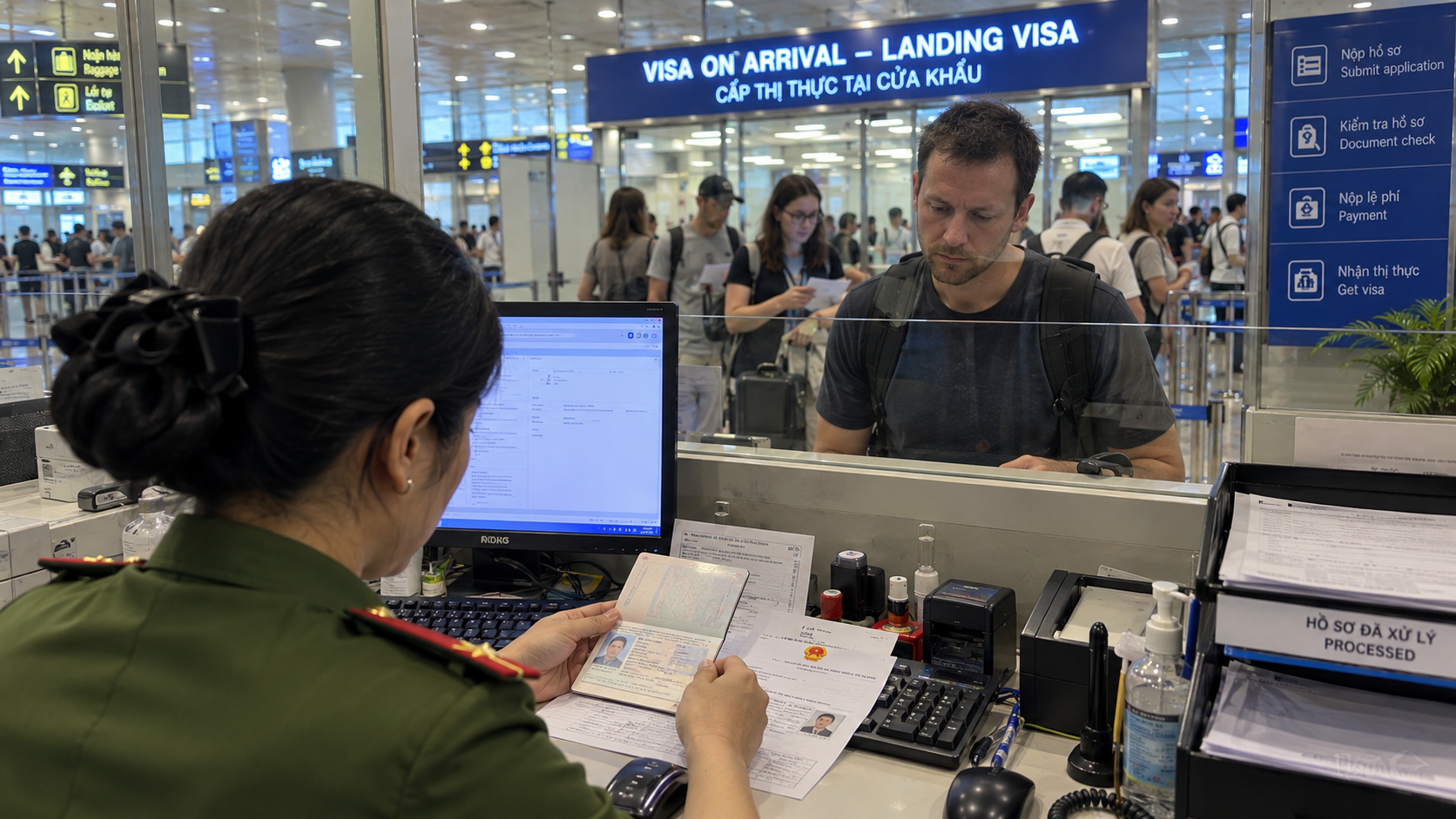
If you intend to use the airport-based process described in this guide, check the airport shown on your actual itinerary before arranging the approval documentation.
Common international arrival airports associated with the process include:
| Destination | International airport |
|---|---|
| Ho Chi Minh City | Tan Son Nhat International Airport |
| Hanoi | Noi Bai International Airport |
| Da Nang | Da Nang International Airport |
| Nha Trang | Cam Ranh International Airport |
| Phu Quoc | Phu Quoc International Airport |
| Da Lat | Lien Khuong International Airport |
Do not assume that a process intended for an international airport automatically applies to a land border or seaport. If your Southeast Asia itinerary changes and you decide to enter Vietnam by road instead of air, the appropriate visa arrangement should be checked again.
That is especially relevant for Irish backpackers or long-term travellers combining Vietnam with Thailand, Cambodia or Laos, where the point of entry can change during the trip.
There is no sensible way to give every traveller one universal processing time. The actual timeline can depend on the application details, submission time, travel date, information requiring review and the procedures applicable to the individual case.
This is why accurate information matters particularly when the flight is close. A passport number that needs correcting or an itinerary that does not match the submitted details can create unnecessary complications.
If you still have plenty of time before flying, the best approach is simply to arrange the paperwork early enough to allow for normal processing and review.
If you are leaving very soon, however, the more useful question becomes:
“What processing option is realistically available before my flight?”
That should be assessed against the actual passport and itinerary rather than answered with a generic promise.
If your departure is approaching, gather the important details first rather than sending a vague request saying only that your visa is urgent.
Have the following ready:
This allows the situation to be reviewed against the amount of time genuinely remaining before travel.
Irish travellers who need assistance can submit their information to our Vietnam Visa Services team for document and itinerary review:
Where an eligible expedited option is available, processing of approximately 2–8 hours may be possible depending on the case, submission time and applicable immigration procedures. The application and passport information can also be checked before processing to help identify obvious inconsistencies that may otherwise create problems later.
Our support team is available 24/7 for questions relating to Vietnam visa applications, approval documentation and entry procedures, with more than 15 years of experience assisting international travellers. Refund arrangements are handled under the applicable service terms and published refund policy. Availability and timing for urgent cases should always be assessed individually rather than treated as an automatic guarantee.
Is the Vietnam pre-approved visa letter the finished visa?
No. Under the process described in this guide, it belongs to the approval stage arranged before travel. The remaining Visa on Arrival formalities still need to be completed at the appropriate airport.
Can I leave Ireland without arranging the approval and deal with it after landing?
You should not assume that the approval-letter process can begin only after you arrive. Where this Visa on Arrival arrangement applies, the approval stage comes before the flight, while the remaining procedure takes place in Vietnam.
Do I need a printed copy of the approval documentation?
You should have the required approval documentation available in the form needed for the arrival procedure. It is sensible to keep the relevant documents readily accessible throughout the journey rather than relying only on an application reference stored somewhere on your phone.
What should I bring in addition to the approval letter?
For the process discussed here, prepare the passport linked to the approval, the completed NA1 form, a 4 × 6 cm white-background photograph and the applicable airport stamping fee.
How much is the airport stamping fee?
For the single-entry visa arrangement discussed in this article, the stamping fee is USD25. It is separate from any service or processing fee associated with obtaining the approval documentation.
Can an Irish traveller request urgent processing?
An expedited option may be available for eligible cases, but the answer depends on the traveller’s documentation, submission time, flight schedule and applicable processing procedures. Complete passport and itinerary information is particularly important when departure is close.
For an Irish traveller, the easiest way to understand a Vietnam pre-approved visa letter is to stop thinking of it as a stand-alone visa product. It is better viewed as one stage in a journey that starts before departure and finishes after arrival.
Before leaving Ireland, make sure the approval documentation has been properly arranged where this route applies, verify that the details match your passport, and prepare the remaining documents you will need in Vietnam. Keep everything accessible while travelling and follow the appropriate airport procedure after landing.
The whole process becomes much easier to understand when reduced to one sequence:
Arrange the approval before you fly, carry the correct supporting documents, and complete the remaining visa formalities after arriving in Vietnam.
If you are travelling from Ireland to Vietnam and your departure date is approaching while your visa is still unresolved, you may be wondering whether you can simply board your …
A business trip can unravel before it begins.
Your Vietnam trip may already be booked, your accommodation confirmed and your itinerary ready, but the visa timeline does not always cooperate with the travel schedule. If departure is only …
Planning a holiday from Ireland to Vietnam? Before confirming your flights, accommodation and itinerary, arranging the correct tourist visa should be one of your first priorities. Vietnam’s electronic visa system …
Your flights are booked, your accommodation is sorted, and your Vietnam itinerary may already include Hanoi’s Old Quarter, the lantern-lit streets of Hoi An, the coastline around Da Nang, and …
Vietnam travel is a thrilling experience, however unforeseen events can happen that need Irish nationals obtaining an urgent visa. Getting a visa swiftly is essential whether it’s for an urgent …