
Imagine that your flight is approaching Hanoi and you are still trying to make sense of the phrase “Vietnam Visa on Arrival.” The name sounds reassuringly simple: arrive at the airport, find the visa counter, submit your passport and arrange the visa before entering Vietnam. That interpretation, however, misses an important part of how an approval-letter-based Visa on Arrival arrangement works. For travellers using this applicable route, Noi Bai International Airport may be the place where the remaining visa formalities are completed, but that does not mean the entire visa application begins only after the aircraft has landed. The relevant approval needs to be arranged before departure, while the airport procedure comes afterwards. Understanding that distinction is particularly important if you already have a flight to Hanoi, because it affects what you should prepare before boarding, what documents you need to keep with you and what you can realistically expect to do after landing. This guide follows the journey in the same order a traveller experiences it, from preparation before the flight to the procedures at Noi Bai Airport, so you can understand exactly where the “on arrival” part fits into the process.
If by “get a visa after landing” you mean completing the applicable Visa on Arrival formalities at Noi Bai International Airport after arriving in Hanoi, this may form part of an approval-letter-based process where that arrangement applies. However, that is very different from arriving in Vietnam first and only then starting the entire approval process from the beginning.
For the process discussed in this guide, the important approval stage takes place before you depart for Vietnam. After the relevant approval documentation has been arranged, you travel with that document and the other required materials, then complete the applicable remaining formalities after landing at Noi Bai International Airport.
A simple way to understand the sequence is:
Arrange the applicable approval before departure → Prepare the required documents → Fly to Hanoi → Arrive at Noi Bai International Airport → Complete the applicable visa formalities → Continue with the immigration process
This distinction matters because the words “Visa on Arrival” describe where an important part of the process is completed. They should not automatically be interpreted as permission to travel to Hanoi without making the required pre-arrival arrangements.
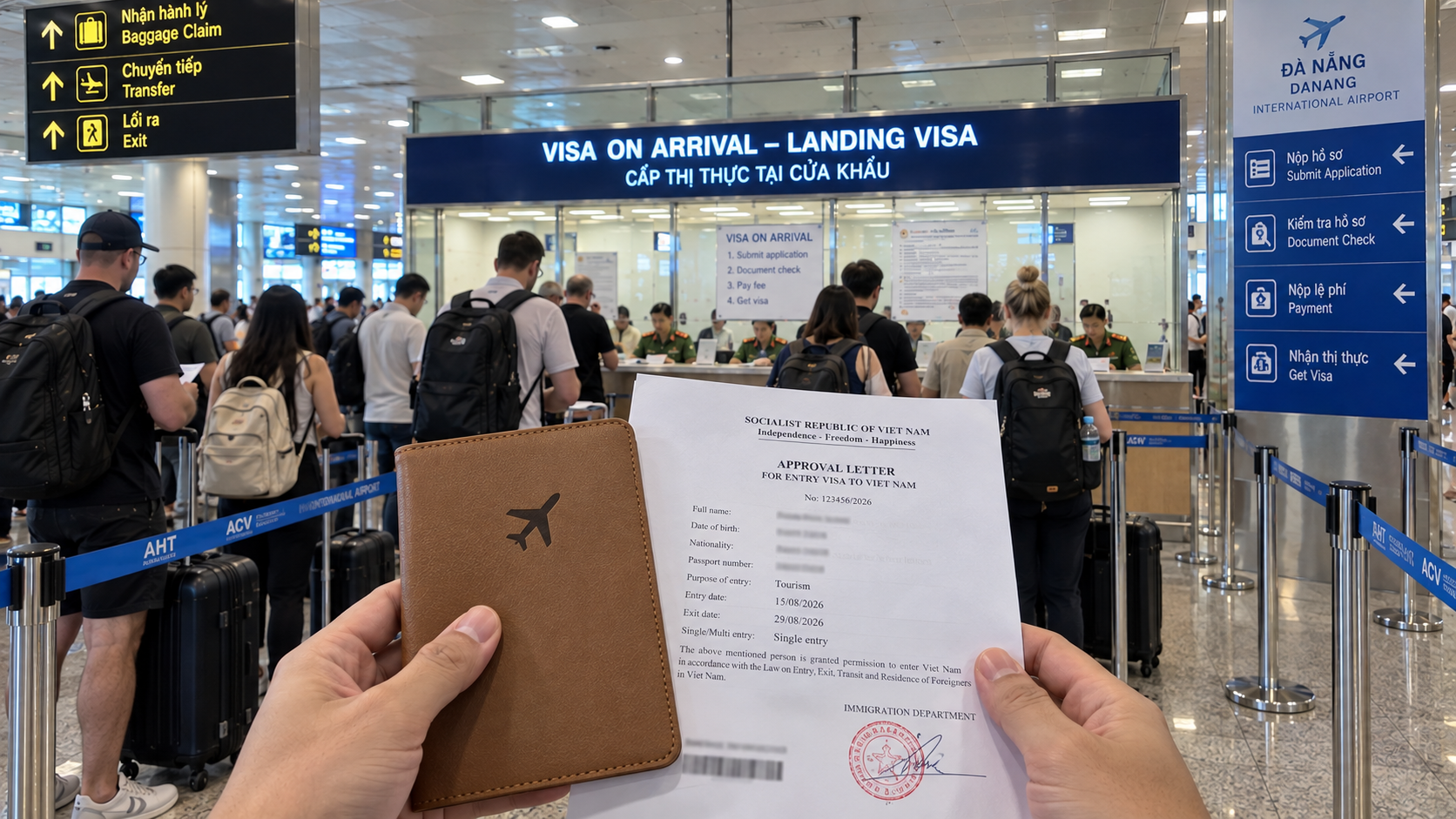
The airport stage makes much more sense once you separate it from the pre-departure stage. Before travelling, a person using the applicable approval-letter route needs to have the relevant approval documentation arranged and should verify that the information corresponds with the passport that will actually be used for the journey.
The traveller should also know the intended arrival date and the actual point of entry into Vietnam. If the journey ends in Hanoi but the traveller first enters Vietnam through another city, the relevant entry point is the airport where Vietnamese immigration is first encountered, rather than simply the final city shown on the itinerary.
This is also the right time to prepare the documents that may be needed after landing. Waiting until the aircraft reaches Hanoi to start looking for photographs, forms or other required materials creates unnecessary difficulty. The smoother approach is to treat the airport procedure as the second stage of a process that has already been prepared before the flight.
One of the easiest ways to understand Vietnam Visa on Arrival is to divide the journey into “before flying” and “after landing.” The two stages are connected, but they do not serve the same purpose.
| Before flying to Vietnam | After landing at Hanoi Airport |
|---|---|
| Confirm that the approval-letter arrangement applies to your case | Present the relevant approval documentation |
| Arrange the required approval before departure | Complete the applicable arrival formalities |
| Check the approval details against your passport | Provide the required supporting documents |
| Prepare your arrival documents in advance | Pay the applicable airport stamping fee |
| Confirm your actual Vietnamese entry point | Continue through the relevant immigration procedure |
This is why an approval letter should not be mistaken for a completely finished visa. It is an important document within the applicable process, but receiving it does not mean that every arrival formality has already been completed.
The reverse misunderstanding can cause just as much confusion. Because some formalities take place after arrival, a traveller should not assume that nothing needs to be prepared before the flight. Both stages matter, and they need to happen in the correct order.
When people search for a visa “at Hanoi Airport,” they naturally focus on what will happen after the aircraft lands. In practice, however, an international journey begins long before the passenger reaches Vietnamese immigration. Depending on the traveller’s circumstances, itinerary and applicable requirements, travel documentation may be checked during airline check-in or before boarding.
For that reason, a traveller should not build a journey around the assumption that any missing visa requirement can simply be dealt with after arriving at Noi Bai. If the applicable process requires approval before departure, that approval belongs in the pre-flight document preparation together with the passport and other necessary travel information.
This is particularly important when the itinerary contains a connection. A passenger might fly through Bangkok, Singapore, Kuala Lumpur, Seoul or another international hub before continuing to Hanoi, but a connecting flight does not change the fundamental need to have the appropriate documentation for the Vietnam journey. What matters is whether the traveller has satisfied the requirements applicable to the chosen entry arrangement before attempting to travel.
Once the relevant approval has been arranged, it is worth preparing the airport documents as a single travel pack rather than treating each item separately. This makes them easier to find after landing and also gives you an opportunity to identify anything missing while you still have time to address it before departure.
For the Visa on Arrival arrangement discussed in this guide, the following items should be prepared:
| Document or item | What to prepare |
|---|---|
| Valid passport | The passport used for the approval and the actual journey |
| Vietnam approval letter | The applicable approval documentation arranged before departure |
| Passport photograph | 4 × 6 cm with a white background |
| NA1 form | Completed for the applicable arrival procedure |
| Stamping fee | USD25 for the single-entry arrangement discussed here |
Keep these documents somewhere accessible in your cabin baggage rather than placing essential paperwork in checked luggage. After an international flight, the last thing you want is to discover that a document required before completing the arrival procedure is inside a suitcase that you have not yet collected.
It is also worth checking the approval information directly against your passport before leaving for the airport. Pay particular attention to your name, passport details and any relevant arrival information shown on the document. If your passport or itinerary has changed since the approval was arranged, verify the situation before travelling rather than assuming the original documentation will automatically remain suitable.
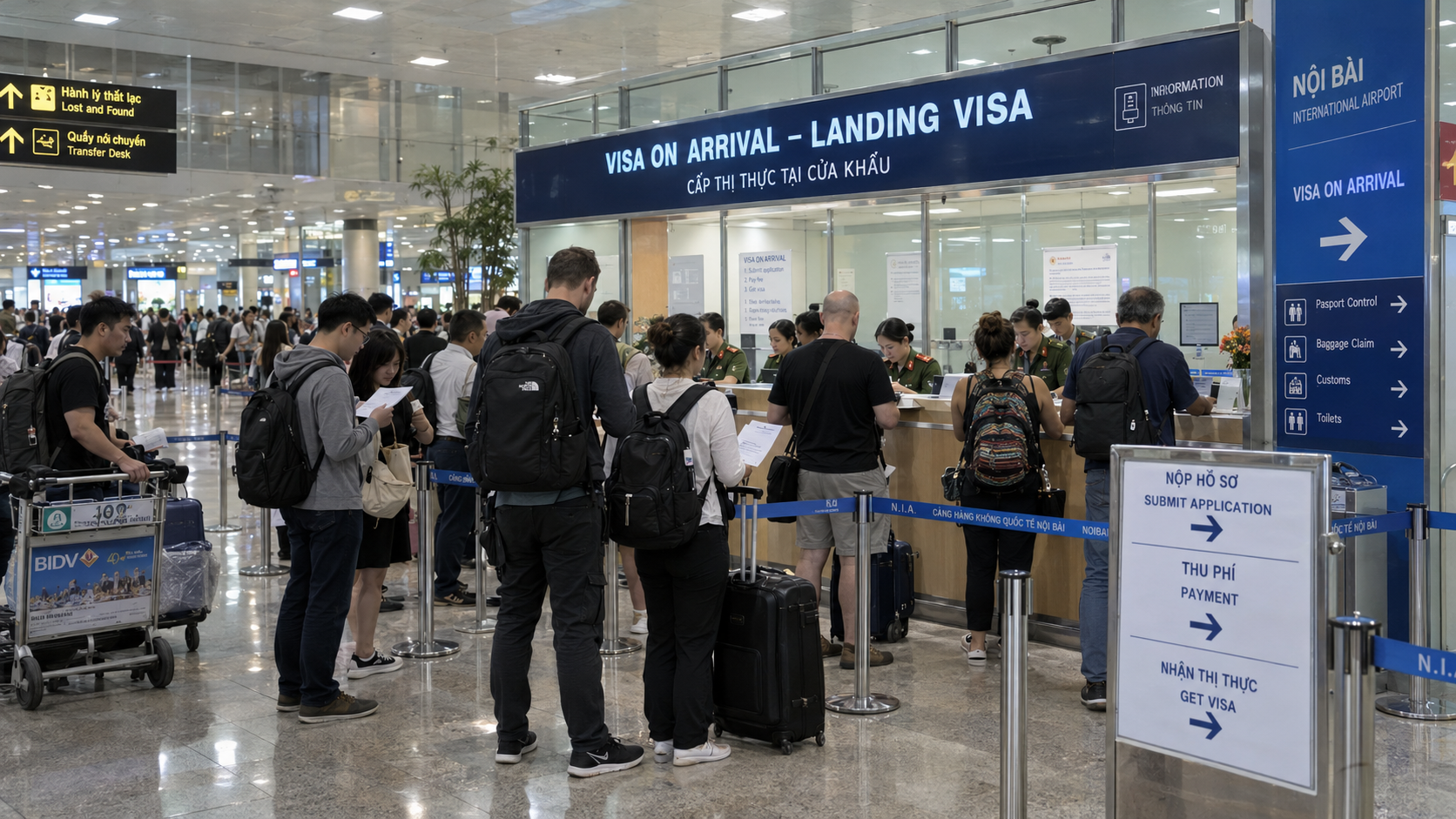
After your flight arrives at Noi Bai International Airport, the next step depends on the entry arrangement that applies to you. If you are using the approval-letter-based Visa on Arrival process described in this article, the airport is where the relevant remaining visa formalities are completed before you proceed through the subsequent immigration process.
This is the stage at which the documents prepared before departure become important. You should have the applicable approval documentation, passport, completed form, photograph and relevant fee ready rather than trying to assemble everything after landing. Once the required visa formalities have been completed according to the applicable procedure, you can continue with the immigration process.
Thinking about the process this way makes the phrase “Visa on Arrival” much clearer. The airport is not necessarily where the entire application begins; it is the place where the arrival stage of an already prepared process is completed.
The first misunderstanding is believing that “on arrival” means no preparation is required before flying. For the approval-letter process discussed here, the opposite is true: the relevant approval belongs to the pre-departure stage, while Noi Bai Airport is associated with completing the later formalities.
The second misunderstanding is treating the approval letter as though it were already the completed visa. The letter is important, but it does not remove the need to prepare the remaining documents or complete the applicable airport procedure. Travellers should therefore avoid looking at an approval document and assuming that every visa-related step has already been finished.
The third misunderstanding concerns fees. Paying for a service that arranges the approval documentation does not necessarily mean the airport stamping fee has also been paid. These amounts relate to different stages of the process, so travellers should understand exactly what is included before paying for a service.
For the single-entry arrangement discussed in this guide, the applicable stamping fee is USD25. This should be distinguished from a service or processing fee that may have been paid before departure to arrange the approval documentation.
The difference becomes easier to understand when you connect each payment to its stage in the journey. A pre-departure service fee relates to assistance with arranging the approval process, while the applicable stamping fee belongs to the airport stage. Paying one should not automatically be interpreted as having paid the other.
Before choosing a visa service, look for a clear explanation of what the quoted price covers. Knowing in advance which amount is paid for processing and which amount may remain payable after arrival makes it much easier to compare services fairly and prepare for the journey.
If you are already at Hanoi Airport without documentation required for your intended entry arrangement, your situation is different from that of someone who is still at home preparing for a future flight. It would not be appropriate to assume that a missing pre-arrival approval can simply be replaced by purchasing a new visa at an airport counter.
In that situation, the appropriate next steps depend on your specific circumstances and the instructions given by the relevant authorities or carrier. General online information cannot determine the outcome of an individual case, particularly where the traveller has already arrived without documentation that may have been required earlier in the journey.
For someone who has not yet departed, the better approach is to resolve uncertainty before boarding the flight. Confirm the visa arrangement that applies to you, check whether pre-arrival approval is required and make sure the documents match your passport and itinerary.
When a flight is approaching and the necessary approval has not yet been arranged, the most useful question is not simply “How fast can I get it?” The first step should be to establish the traveller’s actual situation, because available options can depend on passport details, submission time, intended arrival date, flight schedule and the applicable processing procedure.
If your flight is close, prepare your passport information, intended arrival date, actual entry airport, flight number and departure time. If you already have an existing Vietnam visa application or other relevant documentation, have those details available as well. Providing the complete situation from the beginning makes it easier to assess whether an expedited option may be available.
Eligible urgent cases may have access to expedited processing of approximately 2 to 8 hours, depending on the application, submission time and applicable procedures. This timeframe should not be treated as an automatic guarantee for every traveller; the actual case and flight schedule need to be reviewed first.
If your itinerary involves Hanoi and an applicable approval-letter arrangement is relevant to your case, our Vietnam Visa Services team can assist with reviewing the passport and travel information before processing. This can help identify obvious inconsistencies between the application, passport details and intended journey while there is still an opportunity to address them before departure.
Applications and relevant travel details can be submitted through:
For eligible urgent applications, an expedited option of approximately 2 to 8 hours may be available depending on the individual case, submission time and applicable procedures. Rather than treating a fast processing time as a universal promise, the more reliable approach is to review the traveller’s documents and actual flight schedule before determining which option is appropriate.
Our team provides 24/7 assistance for questions involving Vietnam visa applications, approval documentation and related entry procedures, supported by more than 15 years of experience in Vietnam visa services. Refunds are handled according to the applicable service terms and published refund policy, allowing travellers to review the relevant conditions before using the service.

Can I simply buy a Vietnam visa after I land at Hanoi Airport?
You should not assume that arriving at Noi Bai International Airport allows you to begin the entire visa process from scratch. For the approval-letter-based arrangement described here, the relevant approval is handled before departure, while the applicable remaining formalities are completed after arrival. The distinction between those two stages is essential when planning the journey.
Can I apply for Vietnam Visa on Arrival only after my flight lands?
The process discussed in this guide does not begin only after landing. The applicable approval stage needs to be arranged before travelling, and the airport stage follows afterwards. In other words, completing Visa on Arrival formalities at Hanoi Airport is not the same as submitting the whole process for the first time after reaching Vietnam.
Do I need an approval letter before flying to Hanoi?
If you are using the approval-letter-based Visa on Arrival arrangement described in this article and it applies to your case, the relevant approval belongs to the pre-departure stage. It should therefore be arranged before travelling rather than treated as something to obtain after landing.
What documents should I prepare for the airport procedure?
For the arrangement discussed here, prepare the passport corresponding with the approval documentation, the applicable approval letter, a completed NA1 form, a 4 × 6 cm white-background photograph and the relevant stamping fee. Keeping these items together in your cabin baggage makes them easier to access when needed.
How much is the Vietnam Visa on Arrival stamping fee at Hanoi Airport?
For the single-entry arrangement covered in this guide, the stamping fee is USD25. It is separate from any service or processing charge paid for arranging the approval before departure, so travellers should take both stages into account when reviewing the overall cost.
Can I use the same airport process if I enter Vietnam by land?
An arrangement intended for completion at an international airport should not automatically be assumed to work for a land-border or seaport entry. If your itinerary changes from flying into Hanoi to entering Vietnam by another route, confirm that the entry arrangement remains suitable before travelling.
My flight to Hanoi is tomorrow. Can urgent processing still be possible?
Eligible urgent cases may have expedited options, but availability depends on the individual application, submission time, passport information, flight schedule and applicable procedures. The best assessment can only be made after those details are reviewed together rather than relying on a general processing-time promise.
The most important point to remember is that completing visa formalities after landing and beginning the entire visa application after landing are not the same thing. For travellers using the applicable approval-letter-based process, preparation starts before the flight: the relevant approval is arranged, the details are checked and the supporting documents are organised before travelling to Vietnam.
If you are still preparing for your Hanoi flight, use that time to confirm exactly which entry arrangement applies to you rather than relying only on the phrase “Visa on Arrival.” Once the pre-departure requirements are clear and your documents are properly prepared, the role of Noi Bai International Airport becomes much easier to understand: it is the location for completing the applicable arrival stage, not a reason to postpone necessary visa preparation until after landing.


