

If you are flying to Nha Trang, you will most likely enter Vietnam through Cam Ranh International Airport (CXR). Seeing the term “Visa on Arrival” may make it sound as though you can land first and apply for a Vietnam visa at the airport. In reality, under the applicable approval-letter route, the required approval must be arranged before departure, while the remaining visa formalities are completed after you arrive at Cam Ranh. Here is what you should prepare before your flight and what to expect after landing.
Travellers often search for a “Nha Trang Airport visa” because Nha Trang is their final destination. In practice, international travellers heading to the Nha Trang area generally arrive through Cam Ranh International Airport (CXR).
That distinction matters when you are completing visa-related information. Your hotel may be in Nha Trang, but your actual point of entry may be Cam Ranh. When an application or approval process asks for your entry airport, check the international flight shown on your itinerary rather than simply entering Nha Trang because that is where you are staying.
The same principle applies to connecting journeys. If you enter Vietnam in another city before taking a domestic flight to Cam Ranh, the airport where you first complete Vietnamese immigration is your actual point of entry.
It depends on what you mean by “get a visa after landing.” If you mean completing the applicable airport stage of an approval-letter-based Visa on Arrival arrangement, Cam Ranh International Airport may be relevant where that route applies to your case. However, this is not the same as arriving in Vietnam without the required pre-arrival approval and starting the entire application from scratch at the airport.
For the process discussed here, the relevant approval is arranged before departure. Once it has been obtained and checked, you travel with the required documents and complete the applicable remaining formalities after landing.
The journey is easier to understand in this order:
Check your entry arrangement before travelling → Arrange the applicable approval → Verify the details → Prepare your documents → Fly to Cam Ranh → Complete the applicable arrival formalities
The important distinction is simple: completing a visa procedure after arrival is not the same as beginning the entire visa application after arrival.

A useful way to understand this arrangement is to divide it into two stages. The first happens while you are still preparing for your trip; the second begins once you arrive in Vietnam.
| Before your flight to Cam Ranh | After arriving at Cam Ranh Airport |
|---|---|
| Confirm that the approval-letter route applies to your case | Present the applicable approval documentation |
| Arrange the required approval | Complete the relevant airport formalities |
| Check the document against your passport | Provide the required supporting documents |
| Prepare your form, photograph and other materials | Pay the applicable stamping fee |
| Confirm your actual entry airport | Continue through the relevant immigration process |
This also explains why an approval letter should not automatically be treated as a completely finished visa. It belongs to the pre-departure stage and supports the applicable procedure after arrival.
At the same time, the fact that part of the process takes place at Cam Ranh Airport does not mean you should postpone all preparation until you land. Both stages matter; they simply happen at different points in the journey.
If some visa formalities happen after arrival, it may seem reasonable to leave everything until you reach Cam Ranh. The problem is that your journey to Vietnam starts at your departure airport, not at Vietnamese immigration.
Depending on your nationality, itinerary, chosen entry arrangement and applicable travel requirements, your documents may be checked during check-in or before boarding. If your particular route requires prior approval, planning to resolve that requirement only after landing may therefore be too late.
This also matters when your journey includes a connection. You may travel through Bangkok, Kuala Lumpur, Singapore, Seoul, Guangzhou or another international hub before continuing to Cam Ranh. The connecting airport does not change the fundamental question: have you prepared the documents required for your chosen method of entering Vietnam?
This small detail causes more confusion than many travellers expect. You might have a hotel reservation for seven nights in Nha Trang and naturally think of Nha Trang as your arrival point. From an immigration perspective, however, the relevant location is where you actually enter Vietnam.
If your international flight lands directly at Cam Ranh International Airport and you complete entry procedures there, Cam Ranh is the airport that matters for the journey. Your accommodation being in Nha Trang does not change that.
The situation is different if you first fly into Ho Chi Minh City, complete Vietnamese immigration there and then take a domestic flight to Cam Ranh. In that case, Ho Chi Minh City is your first point of entry. This is why visa information should always follow the real itinerary rather than simply the final holiday destination.
Once the applicable approval has been arranged, prepare the documents you may need after arrival as one travel pack. Doing this before departure gives you time to notice missing or inconsistent information rather than discovering a problem after a long international flight.
For the Visa on Arrival arrangement covered in this guide, prepare:
| What to bring | What to check |
|---|---|
| Valid passport | Use the same passport associated with the approval |
| Applicable Vietnam approval letter | Have the relevant approval ready before travelling |
| Passport photograph | 4 × 6 cm with a white background |
| NA1 form | Complete it as required for the applicable procedure |
| Stamping fee | USD25 for the single-entry arrangement discussed here |
Keep these materials somewhere accessible in your cabin baggage. Important arrival documents should not be buried inside checked luggage that may not be available until later in the airport journey.
Before leaving for your flight, compare the approval information carefully with your passport. Check your name, passport details and other relevant information. If your passport has been replaced since the approval was arranged, or your itinerary has changed significantly, confirm whether the existing documents remain appropriate before travelling.
Once you arrive at Cam Ranh, what happens next depends on the entry arrangement that applies to you. Travellers using the approval-letter-based process discussed here should have their documents ready for the relevant visa formalities before continuing with the subsequent immigration procedure.
This is where advance preparation becomes useful. Instead of arriving with only your passport and trying to work out what is missing, you already have the applicable approval documentation, completed form, photograph and relevant fee organised and ready.
After the applicable visa formalities have been completed, you can continue through the relevant immigration process. For travellers eager to reach a Nha Trang hotel or resort, it is worth remembering that landing at Cam Ranh is not quite the end of the international journey. The entry process still needs to be completed before the holiday properly begins.
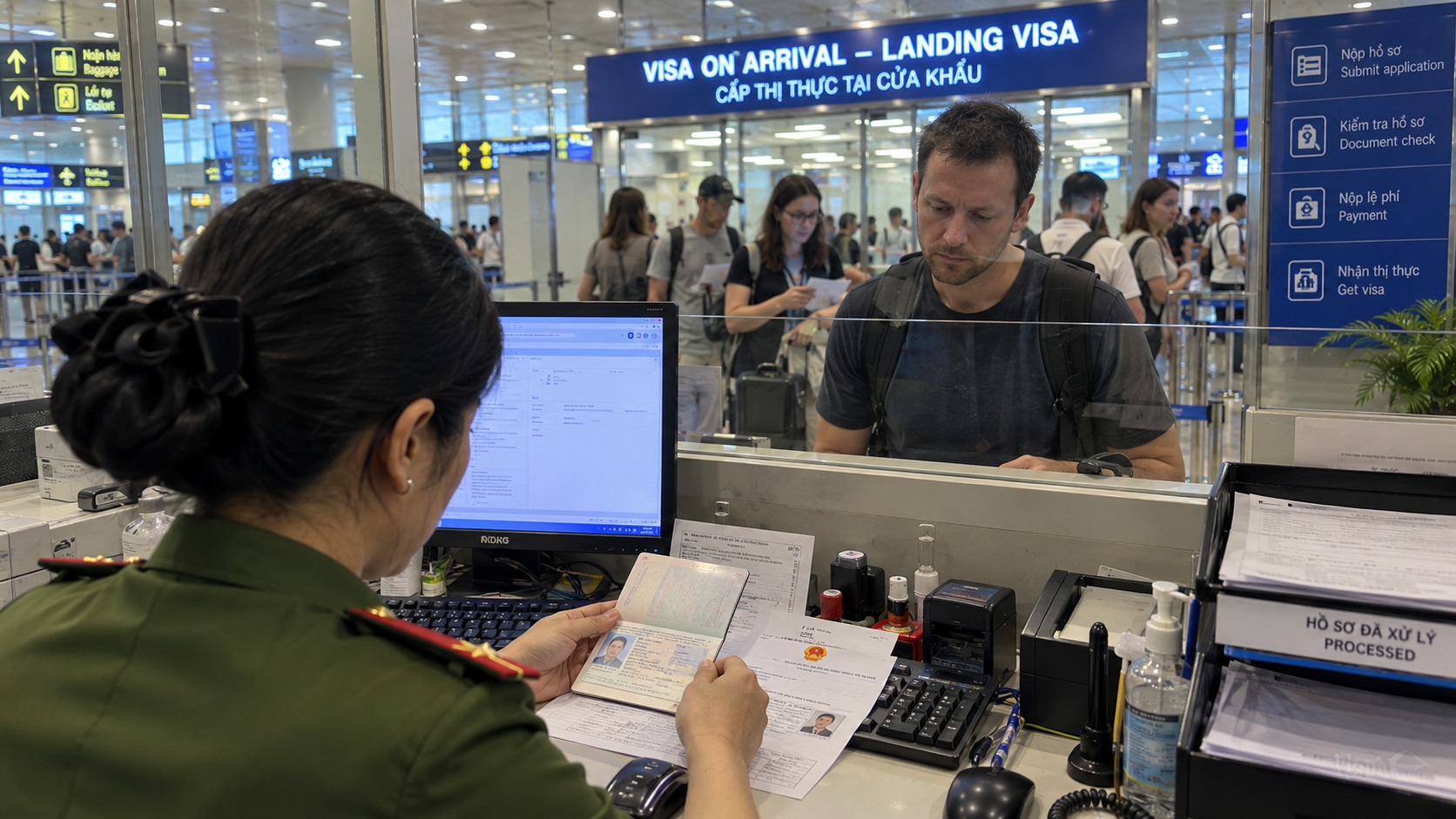
These terms are often mentioned together, which makes it easy to assume they refer to the same stage. They do not.
The approval documentation belongs to the applicable pre-departure process. It is arranged before the journey and used as part of the later airport procedure. Receiving it does not necessarily mean every visa formality has already been completed.
The airport visa formalities take place after arrival, where the applicable remaining steps are completed using the documents prepared in advance.
The stamping fee is another separate part of the process. For the single-entry arrangement discussed in this guide, the applicable fee is USD25.
Understanding these three elements separately makes both the procedure and its costs much easier to follow.
Not necessarily. A service or processing fee paid before departure may relate to arranging the approval documentation, while the applicable stamping fee belongs to the airport stage.
For the single-entry arrangement covered here, the stamping fee is USD25. Travellers should therefore check what a quoted service price actually includes rather than assuming that every airport payment has already been covered.
A clear service should explain the cost structure before you apply. Knowing what is paid before departure and what may remain payable after arrival makes it easier to prepare the correct amount and compare services fairly.
Someone who is still preparing for a flight and someone who has already arrived at Cam Ranh without a document required for their intended entry arrangement are in very different situations.
If you are already at Cam Ranh International Airport without documentation that may have been required before departure, do not assume that you can simply purchase a replacement approval at an airport counter. What happens next depends on your individual circumstances and the instructions provided by the relevant authorities or carrier.
General online guidance cannot determine the outcome of an individual case that has already reached this stage. If you have not departed yet, however, you still have time to confirm which entry arrangement applies, check whether advance approval is required and resolve documentation questions before boarding.
When a Nha Trang trip is approaching quickly, it is natural to focus on processing time. However, whether an urgent option is realistic depends on more than the number of hours remaining before departure.
Your passport details, submission time, intended date of entry, actual entry airport, flight schedule and any existing Vietnam visa application may all be relevant. Preparing this information together makes it easier to assess the situation based on your real itinerary.
For eligible urgent cases, expedited processing of approximately 2 to 8 hours may be available depending on the application, submission time and applicable procedures. This timeframe should not be treated as a universal guarantee; the individual case and flight schedule need to be reviewed first.
If you are travelling to the Nha Trang area through Cam Ranh International Airport and the approval-letter arrangement described here applies to your case, our Vietnam Visa Services team can assist with reviewing your passport and travel information before processing.
This review can help identify obvious inconsistencies between your passport, application details, intended arrival date and actual entry airport before they become more difficult to address close to departure.
You can submit your information here:
For eligible urgent applications, an expedited option of approximately 2 to 8 hours may be available depending on the individual case, submission time and applicable procedures. Our team also provides 24/7 assistance with questions related to Vietnam visa applications, approval documentation and relevant entry procedures, backed by more than 15 years of experience in Vietnam visa services.
Where refunds apply, they are handled according to the relevant service terms and published refund policy. Travellers should review the applicable conditions before submitting an application so that the service scope, processing expectations and refund terms are clear from the beginning.

Can I get a Vietnam visa after landing in Nha Trang?
Where the applicable Visa on Arrival route applies, you may complete the relevant visa formalities after landing at Cam Ranh Airport, but the required approval must be arranged before departure.
Can I arrive at Cam Ranh Airport and start the entire visa application there?
No. The approval-letter process discussed here requires the applicable approval to be arranged before you fly to Vietnam.
Is Nha Trang Airport the same as Cam Ranh Airport?
International travellers heading to Nha Trang generally use Cam Ranh International Airport (CXR), which serves the Nha Trang area.
What documents should I prepare?
Prepare your valid passport, applicable approval letter, completed NA1 form, a 4 × 6 cm white-background photograph and the relevant stamping fee.
How much is the stamping fee at Cam Ranh Airport?
For the single-entry arrangement discussed here, the applicable stamping fee is USD25.
What if I enter Vietnam through Ho Chi Minh City before flying to Nha Trang?
If you complete Vietnamese immigration in Ho Chi Minh City first, that is your initial point of entry rather than Cam Ranh.
Can I use the same procedure if I enter Vietnam by land?
Do not assume so. An airport-based arrangement should be checked again if your itinerary changes to a land border or seaport.
My Cam Ranh flight is tomorrow. Can urgent processing be possible?
Possibly. Eligible cases may have expedited options depending on the application, submission time, flight schedule and applicable procedures.
The easiest way to avoid confusion is to stop thinking of Visa on Arrival as a process that begins only after landing. Under the applicable approval-letter arrangement discussed here, preparation starts before departure: the relevant approval is arranged, the information is checked against the passport and the documents needed for the airport stage are organised in advance. Cam Ranh is then where the applicable arrival formalities are completed.
For Nha Trang travellers, there is one additional detail worth checking carefully. Your holiday destination and your immigration entry point may not have the same name on your booking. Confirm whether you are actually entering Vietnam through Cam Ranh International Airport, make sure your visa-related information follows the real itinerary and complete any required pre-departure preparation before you board.


