

Flying into Ho Chi Minh City through Tan Son Nhat International Airport without a Vietnam eVisa can feel like a serious problem, particularly when your departure date is already close. The good news is that an eVisa is not the only immigration route that may exist in every situation. For travellers using an applicable visa-on-arrival procedure, however, there is one point that needs to be understood before anything else: the process does not begin when you land at Tan Son Nhat Airport. The essential preparation takes place before departure. If your case is eligible for a visa-on-arrival arrangement, you need to obtain the appropriate Approval Letter in advance and carry the required documents with you to Vietnam. After landing at Tan Son Nhat, you then complete the remaining visa formalities before proceeding through immigration. This makes the Approval Letter much more than an optional piece of paperwork—it is the document that connects your pre-arrival approval with the airport visa process. If your flight to Ho Chi Minh City is approaching and you still do not have an eVisa, the smartest approach is therefore not to hope that everything can be sorted out after arrival. It is to know exactly what needs to be secured before boarding, what documents should be in your hand luggage, and what happens once you reach Tan Son Nhat Airport.
A missing eVisa does not automatically mean that every traveller is unable to enter Vietnam through Tan Son Nhat International Airport. Some visitors may qualify for visa exemption, while others may already hold another valid visa or immigration document. The first question is therefore not simply whether you have an eVisa, but what legal basis you intend to use for entry.
For travellers who require a visa and are considering an applicable visa-on-arrival route, the situation is different from arriving as a visa-exempt passenger. A visa-on-arrival procedure involves advance preparation. You should not approach it as a way to fly to Vietnam first and decide what to do only after landing.
This distinction matters because Tan Son Nhat is one of Vietnam’s busiest international gateways, and the fact that immigration and visa-related procedures take place there can easily create the wrong impression. An international airport being capable of handling a visa procedure does not mean a traveller can arrive without whatever prior documentation that procedure requires.
If your intended solution is visa on arrival, your pre-flight priority should therefore be clear: determine whether the route applies to your case, obtain the required Approval Letter before departure, and prepare the documents needed to complete the airport stage.
The term “visa on arrival” makes the airport sound like the starting point of the process. In reality, for an applicable pre-approved airport visa procedure, the most important step may take place before you ever board the aircraft.
The Approval Letter is the document confirming the advance approval connected with the visa-on-arrival route. It should not be confused with the final visa, but it is the document that allows the traveller to move from the pre-travel stage to the airport processing stage when the procedure applies.
That difference is critical. If you have no Vietnam eVisa and intend to use a qualifying VOA arrangement, simply knowing that Tan Son Nhat is an international airport is not enough. You need to travel with the appropriate prior approval already arranged.
Think of the procedure as two connected stages rather than one. The first stage takes place before departure and centers on the Approval Letter. The second takes place after arrival at Tan Son Nhat, when you present your documentation and complete the formalities necessary to obtain the visa.
This is why travellers facing a last-minute visa issue should spend their remaining time securing the approval they actually need rather than searching for reassurance that they can “just get a visa at the airport.”

Tan Son Nhat Airport Border Gate is officially included among Vietnam’s designated international airports for eVisa entry and exit. Travellers who already have a valid Vietnam eVisa can therefore use Tan Son Nhat as an entry point when their visa and journey satisfy the applicable conditions.
Vietnam’s current electronic visa system allows eVisas with a validity of up to 90 days and supports both single and multiple entries depending on the visa issued. For many international visitors, the eVisa remains the straightforward option when there is enough time to apply and receive approval before travel.
The problem arises when a traveller does not yet have a usable eVisa and departure is close. At that point, it is important not to mix the eVisa route with a separate pre-approved airport visa procedure. An eVisa is an issued electronic visa. An Approval Letter used in an applicable visa-on-arrival procedure is advance documentation for a different process.
The fact that both routes can involve entering through Tan Son Nhat does not make them interchangeable. If you already hold an issued eVisa, use the eVisa according to its conditions. If you do not have one and are considering VOA, focus instead on whether the applicable pre-approved procedure is available to you and what must be completed before departure.
When departure is approaching, travellers often spend too much time asking whether they can somehow solve the visa issue after arriving in Ho Chi Minh City. If you need a visa and plan to use an applicable visa-on-arrival route, the more useful response is immediate: prepare the Approval Letter before you fly.
The Approval Letter is the document you need to focus on because the airport portion of the VOA procedure comes later. The sequence should be arranged before the trip rather than improvised after landing.
When only a short amount of time remains, accuracy becomes especially important. Your name, passport number, nationality and other information used in the approval process must match the passport you intend to travel with. An error that might be inconvenient during a normal application can become far more serious when your flight is within a day or two.
If you need to submit a request for an Approval Letter and review urgent processing options for an upcoming Tan Son Nhat arrival, you can start here:
The objective is straightforward: complete the required advance step before departure so that you arrive at Tan Son Nhat with the documentation needed for the next stage instead of arriving with an unresolved visa problem.

One of the easiest mistakes to make is assuming that once an Approval Letter arrives by email, the entire visa process is finished. It is not.
For the visa-on-arrival route discussed here, the Approval Letter represents the advance approval stage. It is the key document you carry to Vietnam, but it should not be treated as though it were already the final visa placed in your passport.
After landing at Tan Son Nhat International Airport, you still need to complete the relevant arrival formalities. That means presenting the documents required under the applicable procedure, paying the corresponding government visa fee and obtaining the visa before continuing through the relevant immigration process.
This two-stage structure is worth remembering because it makes travel preparation much easier. Before departure: secure the Approval Letter and prepare your documents. After arrival: complete the VOA procedure and receive the visa.
Knowing this in advance also prevents a common planning problem. A traveller who receives the approval shortly before departure should not simply save the document on a phone and assume nothing else is required. The rest of the VOA file should be prepared before heading to the airport.
If you are travelling under an applicable pre-approved visa-on-arrival procedure, your document pack should be prepared before you leave home. The most important item is the Approval Letter associated with your VOA arrangement. Check every important personal detail against your passport as soon as you receive it.
You will also need the passport connected to the approval. Do not assume that details can simply be corrected at the airport if they do not match. When an approval is linked to passport information, consistency is essential.
Prepare the relevant Vietnamese visa application form as well. The NA1 form is commonly used for Vietnamese visa applications. Completing the required details in advance can make the arrival stage easier, especially after a long flight into Ho Chi Minh City.
A passport-style photograph should also be prepared. A 4 × 6 cm photo with a white background is commonly requested for this type of procedure. Keeping the photo together with the application paperwork is far more convenient than trying to solve a missing-photo problem immediately after landing.
Finally, prepare the applicable government visa fee. Under Vietnam’s current fee schedule, the fee for a single-entry visa is USD 25. Other visa categories can have different fees, so USD 25 should not be presented as the universal charge for every visa.
Before departure, your practical checklist should therefore include the Approval Letter, passport, required visa application form, appropriate photo and the correct fee for the visa being issued.
Landing at Tan Son Nhat with an Approval Letter does not mean you head directly through immigration as though you already hold the completed visa. You first need to complete the airport stage associated with your visa-on-arrival procedure.
Keep your Approval Letter, passport, visa application form and photo accessible rather than packing them deep inside checked luggage. The documents you need for entry procedures should travel with you in your cabin baggage.
At the relevant visa-processing area, present the documents required under the procedure. Immigration personnel review the information and process the visa in accordance with the applicable rules. This is the point where the distinction between approval and visa becomes practical: the Approval Letter supports the airport process, while the final visa is dealt with during the arrival formalities.
You should also be ready to pay the applicable government visa fee. For a single-entry visa, the current fee schedule sets the charge at USD 25, while other visa types may be charged differently.
Once the required processing has been completed and the visa is issued, you proceed with the next immigration steps for entry into Vietnam. This is why it is useful to arrive with your documentation organized in advance—the airport is where you complete the second half of the process, not where you should be trying to reconstruct the first half.
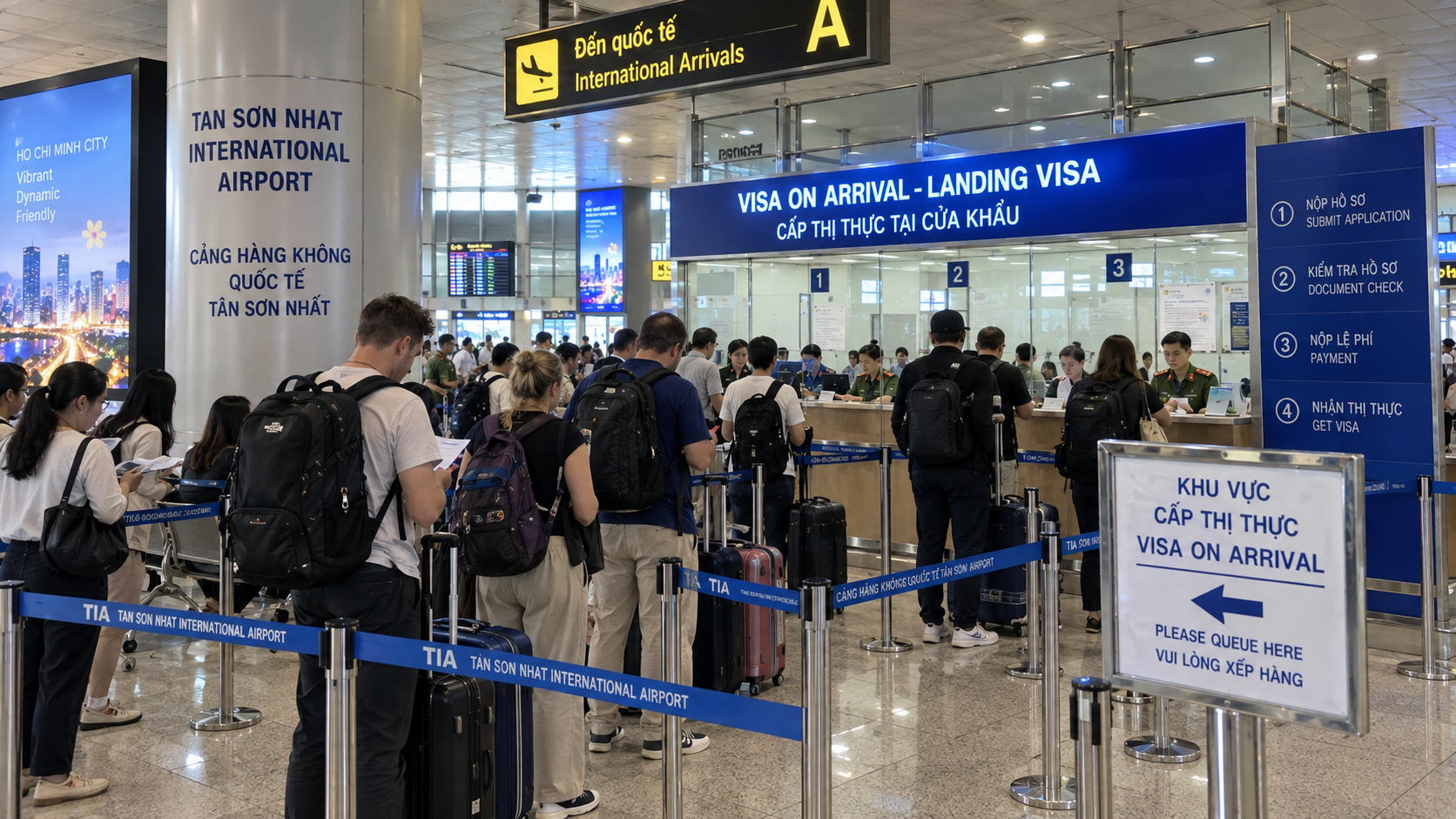
A last-minute visa situation becomes much easier to manage when you stop thinking of it as one large problem and break it into a few concrete checks.
Start with the Approval Letter. If the VOA procedure is the applicable route for your case, confirm that the required advance approval has actually been issued. Do not confuse a submitted request, payment confirmation or processing email with the finished approval document.
Next, compare the Approval Letter against your passport carefully. Check your full name and passport details rather than reading the document quickly and assuming it is correct.
Then prepare your physical arrival materials: passport, relevant NA1 visa form, 4 × 6 cm white-background photo and the applicable visa fee. Keep everything together so you can access it immediately after landing.
Finally, understand what happens at Tan Son Nhat. The Approval Letter gets you to the airport stage of the applicable procedure; it does not remove the need to complete that stage.
This simple preparation strategy helps reduce uncertainty because you know exactly which part needs to be finished before the flight and which part is completed after arrival.
When your flight to Ho Chi Minh City is tomorrow and you still have no usable Vietnam visa, there is little value in reading broad visa guides designed for travellers leaving several weeks from now.
If an applicable visa-on-arrival route is the solution for your case, your immediate task is to obtain the required Approval Letter as quickly as the available legitimate processing route permits. Without the necessary prior approval, you should not build your plan around arriving at Tan Son Nhat and beginning from zero.
You can submit your information and check available urgent processing options here:
Urgency makes accurate information more important, not less. Check your passport number, full name and travel information carefully before submitting the request. If your flight is imminent, make the departure timing clear so the available processing option can be considered against the actual time remaining.
Once the Approval Letter is issued, move immediately to the second part of your preparation. Print or otherwise prepare the required documentation, complete the relevant visa form, have your photograph ready, carry your passport and prepare the applicable visa fee.
The goal is not merely to obtain a document quickly. The goal is to arrive at Tan Son Nhat with an approval and document pack that are ready for the corresponding VOA procedure.
An eVisa and an Approval Letter serve different purposes and should never be treated as different names for the same document.
If you already hold a valid Vietnam eVisa, that eVisa is the visa document you use under the electronic visa route. Tan Son Nhat is officially listed as an approved eVisa airport border gate, so an eligible traveller can enter there using an eVisa in accordance with its conditions.
An Approval Letter used for an applicable visa-on-arrival arrangement works differently. It is prior approval connected to an airport visa process. You present it as part of the VOA procedure after arriving, together with the other required documents.
This distinction becomes particularly useful when comparing last-minute options. If your eVisa has not been issued, you cannot simply rename the pending application an “approval.” Likewise, obtaining a VOA Approval Letter does not mean you suddenly have an eVisa. They are separate immigration processes.
For travellers, the practical rule is simple: know which route you are using before you travel, carry the documents for that route, and do not mix instructions from one process with another.
Can I get a Vietnam visa at Tan Son Nhat Airport without an eVisa?
If you are using an applicable pre-approved visa-on-arrival procedure, the remaining visa formalities can be completed after arrival at Tan Son Nhat. However, the required prior approval should be arranged before departure. It should not be understood as a universal walk-in visa that anyone can start from scratch after landing.
Can I use an Approval Letter at Tan Son Nhat Airport?
Yes, when the Approval Letter has been issued for an applicable visa-on-arrival procedure associated with your trip. You still need to complete the required arrival formalities before receiving the actual visa.
Is an Approval Letter the same as a Vietnam visa?
No. The Approval Letter is the advance approval document for the applicable VOA process. The actual visa procedure still needs to be completed after arrival.
Is Tan Son Nhat Airport an official eVisa entry point?
Yes. Tan Son Nhat Airport Border Gate is included on Vietnam’s official list of air border gates available to eVisa holders.
What should I prepare for a visa-on-arrival procedure?
For the procedure discussed in this guide, prepare the appropriate Approval Letter, your passport, the relevant visa application form, the required passport-style photo and the applicable visa fee.
How much is the Vietnam visa fee for a single-entry visa?
The current government fee schedule sets the fee for a single-entry visa at USD 25. Fees for other visa categories differ.
My flight to Tan Son Nhat is tomorrow. What should I do first?
If a qualifying visa-on-arrival arrangement is the route you intend to use, prioritize obtaining the appropriate Approval Letter and checking whether urgent processing is available for your case. Once it is issued, prepare the remaining arrival documents immediately.
Tan Son Nhat International Airport is a major gateway into Vietnam and an official entry point for eVisa holders, but arriving at a major international airport does not remove the need to have the correct immigration documentation for the route you are using.
If you do not have an eVisa and an applicable visa-on-arrival procedure is your alternative, the Approval Letter is the part that deserves your attention before the flight. Secure the appropriate approval first, prepare your passport, visa form, photo and applicable fee, and arrive knowing that you still need to complete the airport stage before receiving the visa.
For travellers leaving soon, that approach is much more useful than hoping the issue can be fixed after landing. The more clearly you separate the pre-departure approval from the post-arrival visa procedure, the easier it becomes to prepare for entry through Tan Son Nhat with confidence.


